 |
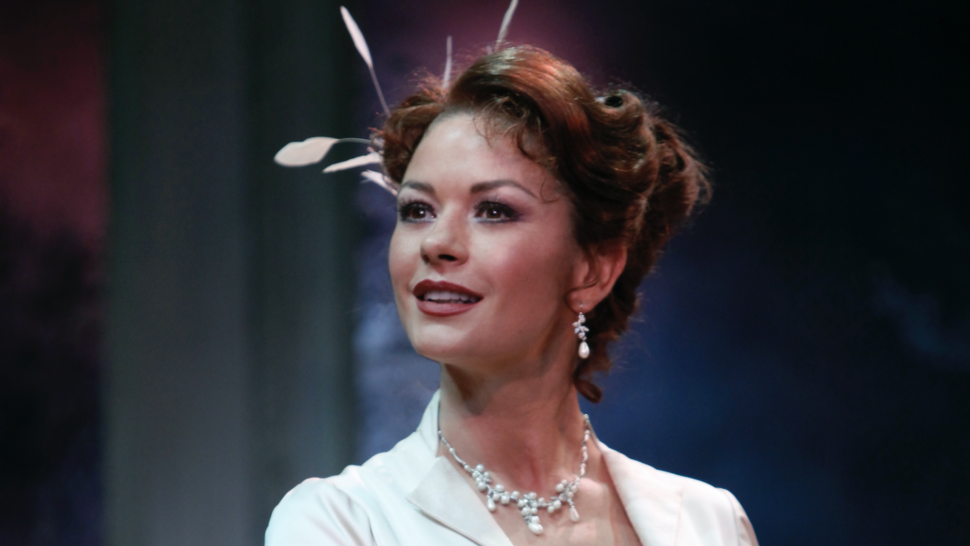
| Catherine Zeta Jones in "A Little Night Music." (Photo by Joan Marcus) |
I'm not sure any Stephen Sondheim show is really underrated anymore—there are passionate partisans for every one, from Anyone Can Whistle to Road Show—but I would still nominate A Little Night Music for the category of under-appreciated (despite containing his one breakout hit song). I'd say this under-estimation might be due in part to the fact that it's not easy to get right—at least, I've never seen a production that fully satisfied as much as the cast albums I've heard do.
Case in point, the show's last Broadway revival, in 2009, a time when it didn't seem likely that Sondheim would ever have a knockout hit. I'd argue that it took until the past few years since his death and the hat trick of Into the Woods, Sweeney Todd, and, amazingly enough, Merrily We Roll Along, for his work to get its full commercial due on the street where he worked his whole career. (Productions like these probably paved the way.) But back in the 2000s, in the aftermath of the stripped-down Sweeney, it seemed to me that Sondheim's destiny would be to occupy a cozy niche in the pantheon rather than a towering pedestal, and I was reconciling myself to that.
I for one couldn't be happier to be proven wrong on this point. I'm also fine with the fact that I was an outlier about A Little Night Music, in that most other critics enjoyed the production and praised its star, Catherine Zeta Jones, who won that year's Tony. I had the enviable if awkward double task of reviewing the show for The Sondheim Review as well as doing a Q&A for the same issue with the very game Zeta Jones. Here they are: First my Q&A, then my review.
Catherine Zeta-Jones Is a Flamboyant and Vulnerable Desiree
But that’s the thing about overnight successes: There’s no such thing. Zeta-Jones, raised in Wales and trained in London, had a long pre-Zorro résumé that began with childhood turns as the lead in Annie and as Tallulah in Bugsy Malone, and peaked with her West End role as Peggy Sawyer in 42nd Street (a part she landed, appropriately enough, when both the lead and the understudy fell ill).
So while it’s been eight years since she’s taken on a major musical role, and by her count 20 years since she’s trod the boards for a full run, Zeta-Jones is making her Broadway debut as Desiree, like herself an actress and mother in her early 40s, in Trevor Nunn’s new revival of Sondheim’s 1973 masterwork A Little Night Music. Remarkably, it’s the musical’s first return to Broadway since its initial run. So, in a sense, both star and show are long overdue for the Great White Way.
Zeta-Jones spoke to The Sondheim Review recently about the show, the cast recording, and why she’s glad to forgo the jazz hands.
How did you get involved with this production? Had you seen the show before, and were you a Sondheim fan?
I was always a Sondheim fan, and I knew the music, but I’d never seen a production. I didn’t really know the complete story of the book. I was literally at the driving range hitting golf balls in Canada when Trevor Nunn called me and said, “I’d love you to play Desiree,” and he told me about his production at the Chocolate Factory in London, and how he was bringing the show back to Broadway. I said, “Well, let me get the book and revisit the songs, and I’ll get back to you within a few days.” And he said, “I think Stephen wants to speak to you.” And I went, “You’re kidding me!” If someone had ever told me, in all my days of dreaming about being in musical comedies, that within 15 minutes I would have Trevor Nunn and Stephen Sondheim calling me on a golf course, I would have said, “Stop taking what you’re taking; get a life.” And he did: 15 minutes later, there was Sondheim on the phone to me saying that he liked my work and he’d like me to play Desiree. So immediately I got the book, and relistened to the score and called them right back and said, “I’m on. When do I start?”
When you looked at the script, what were you first impressions of Desiree? Did you identify with her immediately?
Well, of course. Being an actress at a certain age, one always identifies. It obviously is a different theatre life that she has than my career, but of course you identify with her. I identified with her flamboyancy, her theatricality, and also her vulnerability. There are so many aspects to her. I love her humor, and also the poignant side of her.
Angela Lansbury has said Desiree must not be a very good actress, because she’s always on tour. What kind of actress do you think she is?
They say she’s a famous actress of the time in these small towns. But I think she was probably more of a celebrity than she was an actress.
So you think she puts more of herself and her passions into her personal life than into her acting?
I think her personal life is probably more passionate than her acting. It’s much more colorful than she can be onstage.
Is that a balancing you can identify with—do you pour yourself into both?
Oh, gosh, yes—my life is very full.
Some have said you seem too young for the part. I suppose that’s a kind of backhanded compliment.
No, not really, because it was written for someone in their 40s, and as time has gone on, people in their 50s and even in their 60s have played her. But when you look at the story, she has an 11-year-old daughter, and she’s very attractive and very, very sexually active. I don’t see that as 50s or 60s at all. And when you think of the time in which this is set—being 40 was much older than it is today; it was completely different. So when you put that into perspective, it makes perfect sense.
You seem comfortable onstage. Is that an illusion?
No, I enjoy it. I’m very comfortable onstage.
What accounts for that? You’re just a creature of the theatre?
I think that’s it. When I was growing up, that was my dream. Being a movie star or being on television was never an option for me; I wanted to perform, I wanted to be onstage. Everything else was an added bonus, really. And now, each performance I go on, I can’t quite get my head around how it’s taken 20 years to do this again. I’ve had many different fantastic opportunities that I’ve grabbed and enjoyed and learned from, but it just feels right that I come back now.
Sondheim’s songs are often thought of as very “actable”—that they’re each fully realized scenes unto themselves. Do you find that to be true?
Absolutely. And there’s an intelligence to his work. You don’t just sit back; you have to listen as an audience and think. He doesn’t let the audiences off the hook. His work is extremely witty and complex in a way. Whereas with other musicals, you just sit back and applaud after a big dance number or song, and sometimes you can’t even understand the lyrics because the diction and the articulation is so bad. With a Sondheim piece, you know you have to use your brain, and it’s much more enjoyable evening at the theatre.
Yes, I’d forgotten until I saw it that there are no “buttons” on the end of these songs that invite the audience to applaud. Do you miss that?
No, because the audience just seems to feel when it’s time to be receptive to the end of a song, or a particular scene, and even just the one-liners. A lot of people forget with this piece how incredibly humorous it is. Friends and family and business associates who have come and seen the show didn’t even know how amusing it was.
What’s the biggest challenge of the role, and how do you tackle it?
It’s all the different aspects of her. She’s certainly not a one-dimensional character. She’s not just the ballsy, theatrical, tough broad, but she does have that side. It’s trying to keep all that fresh, and keep all the nuances in the character each night—the vulnerability about where her life is going, as well as having the flamboyance of her. It’s quite a few balls to be throwing up in the air to be able to catch.
So the technical aspects aren’t as much of a challenge?
Well, the technical challenges are always there. People come to see us each night. I’ve been battling through a cold, and my children—I get up to see them off to school at 7 o’clock, then have to take a nap and then go to the theatre. All those things are a challenge, but I’m not the first mother with young children to be treading the boards of Broadway, I’m sure.
How involved was Sondheim in this production? What notes did he give you?
A lot of his notes were very simple: articulation and diction. What is amazing to me is that I have an opportunity to work with a living genius, who, when we did the cast recording was sitting there giving notes and doing his New York Times crossword. It just blows my mind, but there he was, right there.
What was it like working on the recording? I imagine you’ve done a few postproduction recording sessions, but a cast album is something else.
We all worked very hard and did it all in a day. It was very well orchestrated. What was really poignant is that this is probably going to be one of the last Sondheim recordings—not because Sondheim isn’t going to be doing anything else, but because the recording of cast albums is forever diminishing. And so we all felt a great joy and honor to be doing it, especially with him sitting in the booth.
People will want to know how it is to work with Angela Lansbury. So how is it?
She is an inspiration to us all. How dare anyone say they’re fatigued or tired—there she is, eight shows a week. She’s the ultimate professional. She’s a very good friend of my mother-in-law’s and Kirk’s, and I just feel very relaxed around her. I should be completely in awe—I am in awe of her as a person and a career and a talent—but I feel very comfortable around her.
What was Trevor Nunn’s main direction for you, and for the production in general?
In general, it was to keep it real, and for me, because I’ve done so much screen work, it was to remember that there’s an audience out there. Being in a rehearsal room, I found myself reverting to my screen acting technique. It wasn’t until I got into tech that I really found myself back in a theatre.
The group dance at the opening of the show is so dimly lit, I wasn’t even sure when you made your entrance. I guess the idea is to emphasize that it’s an ensemble piece, even though yours and Angela’s names are pretty large on the marquee.
It’s definitely an ensemble piece, and that was one of the things that attracted me to it. I was offered pretty much any revival after Chicago, and I could have picked any one. I waited and waited. I wanted to do something of a caliber that was not, “Oh, there she is, kicking and doing jazz hands—we’ve seen that.” That was one of the great things about this piece: It’s an acting piece for me.
So you don’t miss the singing and dancing—the razzle-dazzle?
I mean, I’ve got that in my back pocket, but do I miss it every night? No, thank you very much. I don’t miss my legs and back and feet aching—no.
Are you hooked on musicals now?
I mean, I’ve been hooked on musicals since I can remember, but I’d love to do a straight play next. I’m just grateful that I’ve been welcomed onto Broadway and feel like I have a home here.
A Shadow of Oblivion
by Rob Weinert-Kendt
Sondheim’s musicals could never be mistaken for Broadway’s blithest confections, but in the 21st century thus far, the revivals of his work seen in New York have been unremittingly stark, dark, and anguished, hammering relentlessly in the key of despair—and, I should hasten to add, very often to the shows’ advantage. The mordant wit of his lyrics not only survives but typically thrives when delivered with the sort of unsweetened punch we associate with Albee or Pinter. And the spidery, contrapuntal architecture of his scores can glimmer anew with sparser instrumentation. As if to ratify this way of seeing his work, the only new Sondheim musical to hit New York during the 2000s, Road Show, proved as tightly focused, and as witheringly bleak, as anything he’s written.
You wouldn’t think this darkness-at-noon approach would work with A Little Night Music, his frothy 1975 adaptation, with Hugh Wheeler, of Ingmar Bergman’s saturnine sexual roundelay Smiles of a Summer Night. And, in many important ways, it doesn’t work, though it’s not for lack of trying. The opening waltz, with dancers switching partners willy-nilly in light dim enough to hide in, and an orchestra of eight marking the time steadily, even grimly, sets a dark and anonymous tone. It’s an off-putting choice, though it seems to be taking its cue from the chilling kickers in the repeated chorus of “Remember?”: “I think you were there” and “I’m sure it was you,” lines that suggest, amid the song’s winking erotic reveries, that not only love but lust is blind.
This shadow of oblivion almost qualifies as this production’s overarching idea—that precisely which beds the show’s hapless characters end up in doesn’t ultimately matter very much; death is the final punchline, whether or not we’ve had a chance to get the joke, as even the wise Madame Armfeldt (Angela Lansbury) must finally admit. In this context, the three “smiles” that, in her telling, a summer night casts over the follies of young, middle-aged, and old lovers seem less warmly indulgent than cold, indifferent, Olympian.
As is often the case with Sondheim, his wit can gleam all the more sharply in a resolutely dark-hearted production. This, and the leisurely tempi, may account for the way some lyrics here acquire a delicious bite, in particular the densely rhymed equivocations of Fredrik Egerman’s “Now,” rendered with Sprechstimme tartness by the excellent Alexander Hanson. The problem is, Nunn’s production isn’t resolutely anything for very long—it plays like a mish-mash of Chekhov, operetta, and crude sex farce—and the aforementioned existentialist “idea” doesn’t inform the production so much as dampen it.
Still less forgivable are a number of casting gaffes. Not the magisterial Lansbury, of course, who initially seems a tad broad for the role but finally makes the case for Madame Armfeldt’s primacy—she may have just one big solo, but she does open and close the show, after all.
Hanson makes an especially fine, unflashy Fredrik; Aaron Lazar makes a tightly wound Count Carl-Magnus, and Erin Davie, as his long-suffering wife Charlotte, turns her lines into surprising whirligigs of comic despair. And Leigh Ann Larkin is a passable Petra. But both Larkin and Hanson are terribly served by their romantic counterparts: As Henrik, Hunter Ryan Herdlicka has a lovely voice but his take on this horny young seminarian is callow to the point of dewy, and as Fredrik’s virginal coquette of a bride, Anne, Ramona Mallory gives a screechy, silly, nearly unbearable performance.
Did I forget to mention anyone? Yes, yes, I know. At the center of this two-legged waltz, there is the matter of Catherine Zeta Jones. First, the good news: She is lovely, and she’s not a bad singer; it’s not difficult to see the many things the camera loves about her, and she has a certain comfort in her own skin that’s rare for movie stars subjected to the glare of the footlights.
Her confidence is undeserved, though, for Zeta Jones here proves herself one of those stars whose full brilliance comes through best via the close-in, multiple-take gaze of the cinema. She doesn’t kill the buzz of this Night Music—there’s little buzz to kill—but she does render several of her scenes with the slightly stilted clumsiness of the untrained (she botches “You Must Meet My Wife” opposite a game Hanson; she seems lost in the odd transitions between the choruses of “A Weekend in the Country”). And while her voice projects reasonably well, her diction is garbled—a shame not only for the spiky litany of indignities in “The Glamourous Life” but even for the heartfelt “Send in the Clowns,” which she acts movingly but sings unconvincingly.
Truth to tell, once we’re used to Nunn’s no-frills, no-thrills approach, the second act settles into a reasonably enjoyable rhythm, and the show’s mature, unsentimental romance works a fair bit of the seduction it’s meant to. Even so, this hardly feels like a triumphant return to Broadway after 35 years; and the most awkward thing about the casting of Zeta Jones is that her presence is the only reason the show is on Broadway at all. Nunn’s downer conception, not to mention the tiny orchestra and the unit set, don’t exactly beg for such a big canvas, let alone a three-digit ticket price.
Perhaps it’s best to view this disappointing revival less as a fully realized revisioning of a great work than a kind of marker—a transitional point in the gradual, inevitable, and ultimately healthy de-Broadway-ification of Sondheim. As great as John Doyle’s revivals have been, after all, they weren’t exactly blockbusters; and minus a staging concept to justify the puniness of the band, the imported Sunday in the Park revival sounded as tinny as it looked marvelous. This dim Night Music may help get the painful message across: Sondheim may be as great a musical dramatist as has ever penned a showtune, but no amount of visionary direction or star power or years of familiarity is likely to make one of his revivals a Chicago-style sensation or garner Hair’s extensions. For Sondheim, the smile of posterity will be no less broad without Broadway’s blessing.




.jpg)