Oct 7, 2009

You Know, For Kids


Spent the day yesterday at the New Victory's informative forum on children's theater, with special guests from Edinburgh's leading-edge Imaginate festival exchanging ideas and contacts with stateside artists and educators. I was struck above all by how the Scots' motivation was more toward artistic expression than education, a point beautifully proven by Andy Manley's deft, disarming show for under-threes, My House, and even more exquisitely demonstrated by Puppet State's The Man Who Planted Trees, which on its face couldn't be a more didactic environmental fable but which in performance plays like the best sort of three-dimensional story theater; the impulse to tell the story is inextricably bound up in its execution, and it doesn't feel like it's meeting any kind of externally imposed instructional mandate. It reminded of a Kurosawa quote I came across recently, in which he said of noh theater, "The style and the story are one." In short, I was enchanted, and if you've got a young one--the recommended age for Man Who is 7 and up--I'd hurry to the New Victory posthaste.

Oct 5, 2009

Denise Makes Good


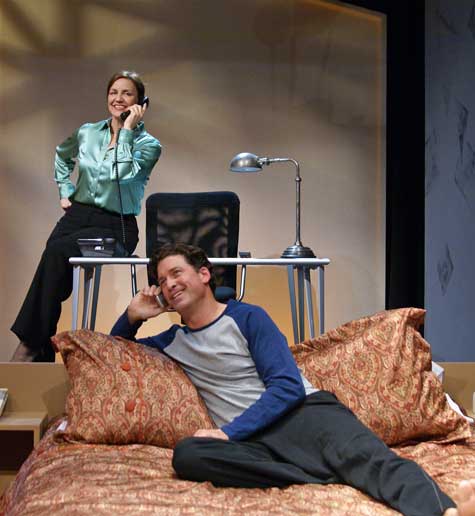
(Denise Poirier and Paul Drinan)

One of my favorite actors from L.A., Denise Poirier, relocated to Maine around the turn of the millennium, and she's been acting up a storm ever since. Her latest turn: as Diane, the acerbic agent in Douglas Carter Beane's The Little Dog Laughed at Portland's Good Theatre. As the Boston Phoenix enthuses: "Who but Poirier to portray the imperious, caustic, and wickedly glib Diane?"

I can only imagine how Diane's most infamous line (to L.A. theater boosters, anyway) rings in Denise's ears: "We don't have a problem with cell phones in the theatre in this town. We've simply stopped doing theatre altogether." That's why they call it acting, I guess.

The Science of Remounts

In discussing the daunting challenges of moving Off-Broadway hits that seem to belong in their intimate birth spaces up into larger houses to cash in on wider demand, Bernard Gersten, writing in the Lincoln Center 50th Anniversary review, offers this beguilingly silly yet somehow persuasive flight of fancy:
We did move [House of Blue Leaves] up. And, of course, the lesson learned was the same lesson that I had learned some years earlier, when we moved A Chous Line, which was perfect in this three-hundred-seat configuration at the Public's Newman Theater. We wondered how it could possibly move to the Shubert Theatre with fifteen hundred seats.

The answer was: when you add a thousand people you add theatrons, which are the unit of theatrical energy. They're like electrons or ions or protons. They are given off by various theatrical things--actors, playwrights. Words give off theatrons. Words delivered add more theatrons. Actors with virtuosity add more theatrons. The room acts as kind of a magnifier--a reflector, like one of those orgone boxes of Wilhelm Reich. You release the theatrons, they bounce against the wall and then bounce back into the work onstage, and the energize it and give it sexual energy. The way orgasms worked for Wilhelm Reich. A theater without a roof is hopeless! All the theatrons escape through the open top!

I think he might have stopped before the Reich business, but hey--it's a metaphor, and it has a ring of truth.

Except, of course, for that roof-less business. Leaving aside the Delacorte and other outdoor venues where I've experienced as much or more theatrical magic as in any indoor space, just consider the actual meaning of theatron: a Greek theatrical arena.

Unconventional Wisdom

Two items caught my interest in ostensibly non-theater-related reading. First, Anthony Tommasini's piece about opera revisionism, successful and un-, he has this striking lede (emphasis mine):
ALTHOUGH opera might be healthier if die-hard fans were as intensely curious about new works as theatergoers are, you have to admire the passion with which opera enthusiasts defend the staples.

That's not something you hear very often, but he's got a point, at least comparatively speaking. And this response from a reader of CultureGrrl's ArtsJournal blog offered a point of view on the Times' arts coverage I've never considered:
There is a marked preference on the part of the Times' editors for coverage of performing arts over fine arts in the cultural pages.

So theatergoers love new works and there's plenty of performing arts coverage in the Times? Don't quote me on that.

The Medium, The Message


Corner of Milton & Franklin, Greenpoint.

Oct 2, 2009

Mosher's Pickle Jar


Director Gregory Mosher, now at Columbia after decades as an influential theater (and film) maker in Chicago, New York and London, will headline a chat about the uncertain future of the performing arts this coming Monday, Oct. 5, at 6 p.m. at the Picnic Market Cafe. Details here.

Funny thing, I was just reading Lincoln Center's 50th anniversary retrospective today, and in the story about the troubled history of the Beaumont, it's commonly acknowledged that Mosher is the A.D. who cracked the theater's secret code and turned the place around with the 1986 production of House of Blue Leaves, and a series of hits that included Anything Goes, Sarafina!, Our Town, and Six Degrees of Separation.

But, Helen Sheehy's article relates, he remains disarmingly modest about his success:

"Everybody had been trying to get the lid off the pickle jar for years," he said, "and the guy who finally does it doesn't deserve the credit."

Babelfish Strikes Again

Got this email today from a Russian theater in Chekhov's hometown, responding to a fact-checking question:
Expensive colleagues!

Festival in Taganrog the seventh under the account. The following festival is planned in September, 2010.

With pleasure we invite you to take in it part in quality of guests of honour!

"Expensive colleagues" is so much more attention-grabbing than "dear friends," don't you think?

UPDATE: One of the productions at that Russian theater's upcoming theater festival is something called "Five poods of love," which is not a mistranslation--it refers to a description Chekhov once offered of The Seagull, as detailed here:
In a letter to his friend Aleksei Suvorin as he was finishing The Sea Gull, Chekhov said that it contained 5 "poods" of love, along with four acts, a landscape with a lake, very little action, and a lot of talk about literature.2 A pood was a pre-metric Russian weight measure equivalent to 16 1/2 kilos or 36 lbs. So we have 180 pounds of love in the play, which I take as a lot.